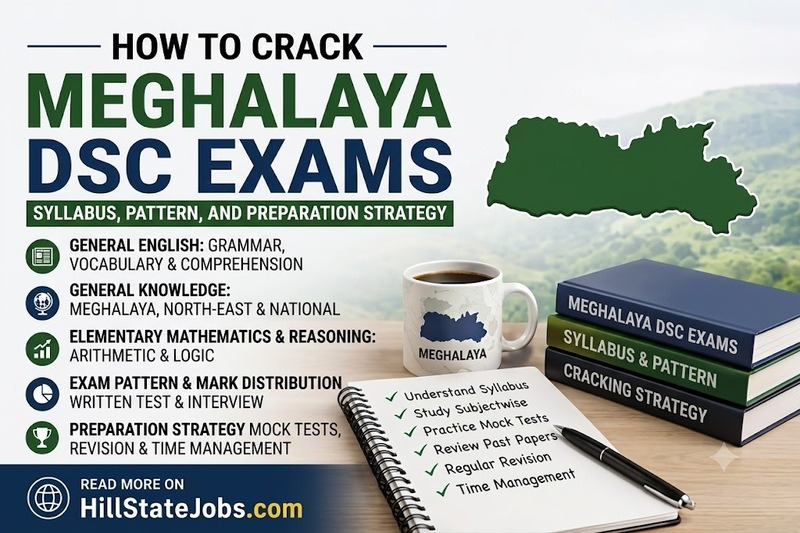
Welcome to the definitive guide for your Meghalaya DSC exam preparation. If you are a local job seeker aiming for a stable, respected government position, securing District Selection Committee jobs is an excellent opportunity. The DSC conducts recruitment for crucial district-level Grade C and Grade D positions, including Lower Division Assistant (LDA), Typists, Gram Sevak, and Section Assistants.
Also read: How to Prepare Meghalaya Current Affairs for MPSC: Complete Guide
Understanding the Meghalaya DSC Exam Pattern
Before diving into the books, you must clearly understand the Meghalaya DSC exam pattern. The recruitment process typically involves a Written Examination, followed by a Skill/Typing Test for specific roles, and finally a Personal Interview.
Additionally, candidates must now pass a mandatory qualifying paper on the local language of their respective district (Khasi, Garo, or Jaintia). Here is a breakdown of the typical written exam structure:
| Subject / Test Phase | Format | Key Details & Weightage |
|---|---|---|
| General English | Objective / Descriptive | Focuses on grammar and comprehension (Approx. 30-40% weightage). |
| General Knowledge | Objective | State, national, and current affairs (Approx. 30-40% weightage). |
| Elementary Mathematics & Simple Reasoning | Objective | Class 10 standard arithmetic and logic (Approx. 20-30% weightage). |
| Local Language (Qualifying) | Translation & Essay | 100 Marks total (Minimum passing score is strictly 30). |
Detailed Meghalaya DSC Syllabus Breakup
To study effectively, you need to break down the DSC Grade C and D syllabus into manageable sections. Focusing on these core topics will prevent you from wasting time on irrelevant material.
General English
English proficiency is heavily tested, especially for clerical and typing roles. Build a strong foundation in high school-level grammar.
- Grammar Rules: Master tenses, active and passive voices, direct/indirect narration, and subject-verb agreement.
- Vocabulary: Regularly practice synonyms, antonyms, spelling correction, idioms, and phrases.
- Comprehension: Practice unseen passages and sentence improvement exercises to boost your reading speed.
Mathematics & Reasoning
This section is designed to test numerical accuracy and logical thinking. The difficulty level is strictly maintained at the elementary or Class 10 standard.
- Arithmetic: Focus on percentages, profit and loss, averages, ratio and proportion, and time/work/distance word problems.
- Basic Mensuration: Learn formulas for the area, perimeter, and volume of simple geometric shapes.
- Simple Reasoning: Practice number series, analogies, and basic situational logic puzzles.
General Knowledge
The GK section is vital and highly scoring. You must balance your knowledge of national events with deeply specific local information.
- Meghalaya & North-East GK: Study the history, geography, local tribes, cultural festivals, and prominent landmarks of Meghalaya.
- Current Affairs: Stay updated on recent state developments, national news, sports, and international events.
- Static Awareness: Review the basics of the Indian Constitution, everyday science, and historical freedom movements.
Step-by-Step Preparation Strategy for DSC Exams
Mastering the DSC syllabus Meghalaya requires consistency. Follow this structured routine to ensure you cover all bases before exam day.
- Enforce Daily Time Management: Dedicate distinct hours for English, Math, and GK every day. Do not leave mathematics for the last minute.
- Focus on Local Context: District-level exams heavily favor local knowledge. Read local newspapers daily to stay sharp on state affairs.
- Solve Previous Years’ Papers: Practicing past DSC papers helps you identify recurring question patterns and improves your confidence.
- Take Timed Mock Tests: Simulating exam conditions trains your brain to handle pressure and improves your overall answering speed.
Best Books and Study Material for Meghalaya DSC
Your preparation is only as good as your resources. Equipping yourself with standard Meghalaya DSC preparation books is essential for a competitive edge.
- General Knowledge: Lucent’s General Knowledge is the standard for static GK, alongside specific state guidebooks detailing Meghalaya’s history.
- General English: Objective General English by S.P. Bakshi or the classic Wren & Martin will cover all grammatical bases.
- Mathematics: Quantitative Aptitude for Competitive Exams by R.S. Aggarwal is highly recommended for mastering basic arithmetic concepts.
How to Master the DSC Typing Test (For LDA & Typist Roles)
For clerical candidates, clearing the written exam is just phase one; you must also pass a strict practical test. Knowing the Meghalaya government typing test rules is crucial for final selection.
The selection committee looks for a perfect balance of speed and flawless accuracy. High speed with too many errors will result in immediate disqualification.
- Practice Daily: Spend at least 30 to 45 minutes every day on typing software to build permanent muscle memory.
- Prioritize Accuracy Over Speed: Focus on typing with 100% accuracy first. As your fingers learn the keys, your speed will naturally increase.
- Simulate Exam Layouts: Practice typing directly from printed sheets of paper rather than the screen, as this mimics the actual test environment.
Frequently Asked Questions
What is the mandatory local language paper in Meghalaya DSC exams?
It is mandatory for candidates applying for all District Selection Committee posts to clear a qualifying paper on the knowledge of the local language of that particular district. The total marks for this paper are 100, and the minimum pass mark is strictly 30.
What is the syllabus for the local language qualifying test?
The test requires translating common words and sentences between English and the local language, such as Khasi or Garo, which accounts for 70 marks. Additionally, candidates must write a 500-word essay in the local language on a topic related to the State of Meghalaya for 30 marks.
What is the age limit for Meghalaya DSC recruitment?
The general age limit is between 18 and 32 years. However, there is a 5-year age relaxation provided for SC and ST candidates. Government employees have no age bar but must produce a No Objection Certificate (NOC) during the interview stage.
What is the typical selection process for DSC jobs?
The selection process generally involves three main stages: a mandatory Qualifying Test in the local language, a Written Examination, and a final Interview or Practical/Skill Test depending on the specific post.
What are the educational qualifications for clerical or assistant posts?
Qualifications vary widely by post. For example, roles like Record Keeper and Copyist require an SSLC (Class 10) pass. Other positions, such as Assistant Enforcement Inspector, require passing HSSLC (Class 12) or equivalent, along with a mandatory DTP Computer Course.
Can anyone from Meghalaya apply for any district’s DSC recruitment?
Generally, no. Applications are typically restricted to permanent residents of the specific district conducting the recruitment (for example, only permanent residents of East Khasi Hills can apply for DSC East Khasi Hills jobs).